
2 posts tagged with "emergency-response"

View All Tags

Beyond the Agent Hype: 5 Engineering Rules from 10 Weeks of Building Bounded AI Systems

· 10 min read
Suresh Thomas
Founder, JigsawFlux

Ten weeks, nine posts, and four working systems.

The practical question behind all of it: how do you build useful AI systems where cost, connectivity, data privacy, and human accountability are hard constraints?

The industry narrative is dominated by cloud-first, fully autonomous agents operating with unlimited budgets. JigsawFlux took a different direction: local inference, offline-first architectures, Kubernetes home labs, and strict state-machine controls.

The path is visible in retrospect: direct local LLM wrappers gave way to stateful agent workflows, which gave way to bounded edge systems for clinical consultation, travel risk assessment, and NHS appointment recovery.

This is what those nine posts covered, what connects them, and the five engineering rules that emerged from the work.
8 Agentic Patterns in Practice: One 999 Call, Eight Different Agents

· 21 min read
Suresh Thomas
Founder, JigsawFlux

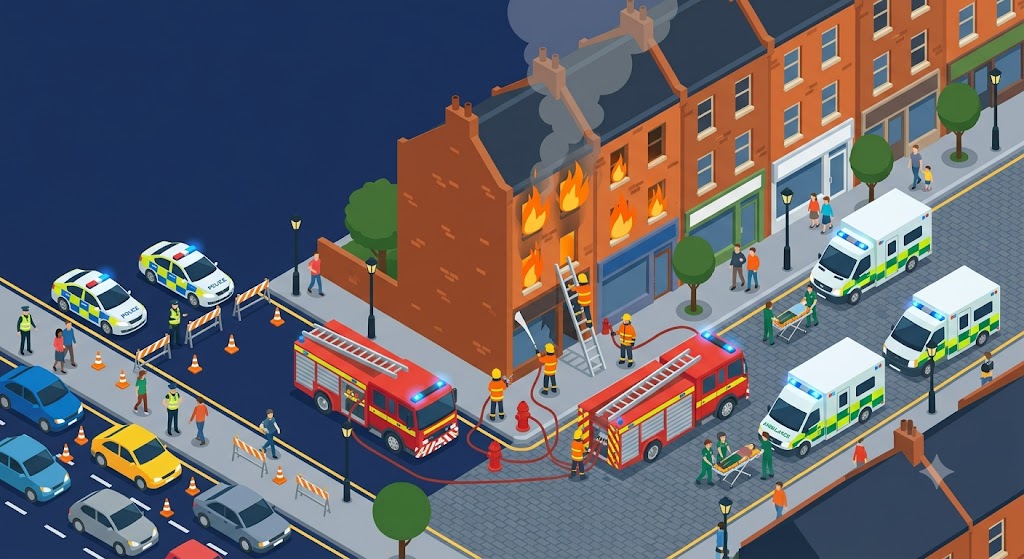
A 999 call comes in: a 3-storey building is on fire, casualties are reported, and High Holborn is gridlocked. The Incident Commander has roughly 90 seconds to answer four questions. Which hospital can take burns patients — and is it under pressure? How many pumping appliances does the NFCC minimum require for a multi-storey structural fire? Which traffic corridor can the ambulances actually reach? And does this cross the threshold for a formal Major Incident declaration?

Which agentic pattern you use to support that decision changes everything — not just how fast the answer arrives, but whether the answer is auditable, protocol-compliant, and safe to act on without a human double-checking it.

This is Part 2 of the JigsawFlux series on open-source agentic frameworks. Part 1 compared LangGraph, CrewAI, and AutoGen at the framework level. Part 2 puts eight specific reasoning patterns — ReAct, ReWOO, Plan-and-Execute, Reflexion, Hierarchical, DAG, Network/P2P, and Consensus — through the same incident and measures what each one actually does. The full source is at github.com/JigsawFlux/agentic-patterns.

Fictional emergency response scene — isometric illustration of a 3-storey building fire with fire engines, ambulances, and police vehicles coordinating in an urban London setting